
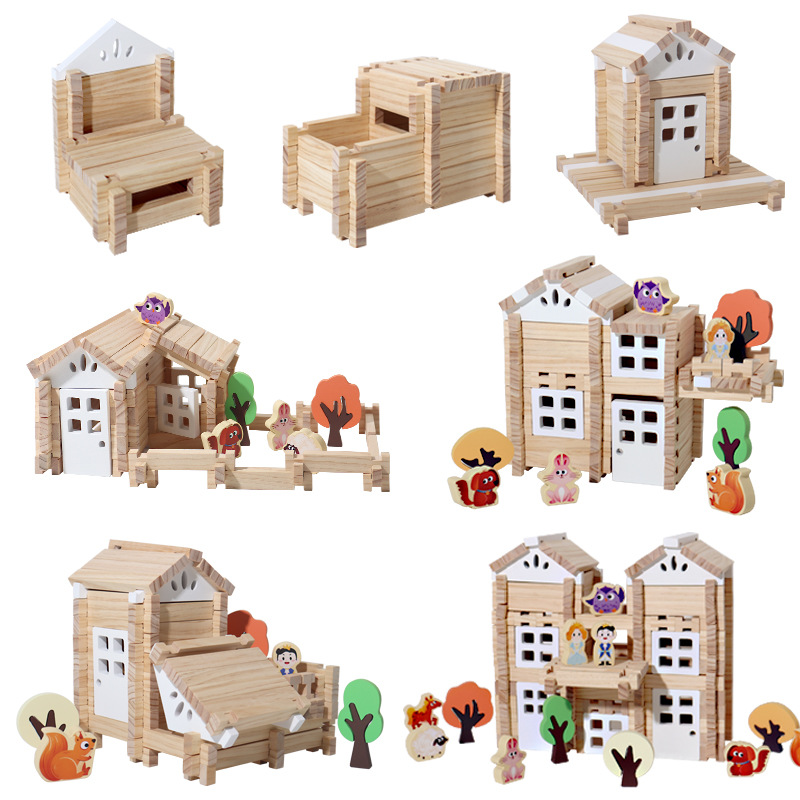
New DIY Wooden House Ancient Capital Moon Viewing Creative Retro Japanese Style Hand Assembled Building Model Villa Toy
Scale: 1:24 Miniature • Material: Basswood
Source high-demand kinetic structures, architectural models, and precision joinery sets. Fully verified for retail performance, ASTM F963, and EN71 safety criteria.





The global juvenile products and hobbyist markets are witnessing a structural transition. Mechanical toys—spanning gear-driven automotive models, kinetic automata, interlocking architectural assemblies, and biomimetic robot assemblies—are displacing purely static playthings. As digital screen saturation peaks in developed consumer demographics, parents, educators, and adult collectors are deliberately re-allocating discretionary spend toward physical, screen-free mechanical engagement. This procurement paradigm requires modern B2B category managers, independent retailers, and educational distributors to re-evaluate their supplier selection parameters beyond basic unit costs.
Historically, low-cost battery-operated toys held retail prominence. However, strict international regulatory shifts concerning lithium-ion transport, circular material directives, and micro-plastics are reshaping procurement requirements. Today’s wholesale buyers are prioritizing three technological and material transitions:
Global logistics regulations are increasingly penalizing uncertified hazardous battery inclusions. Importers are steering inventory toward gravity escapements, rubber-band inertia systems, hand-crank cams, and wind-up counterweights that circumvent battery compliance while maintaining high interactive kinetic motion.
The cross-pollination of traditional Chinese Luban mortise-and-tenon (Sunmao) joinery with European STEAM curricula has created an entirely new market segment. By discarding synthetic adhesives in favor of mechanical interlocks, these toys eliminate chemical VOC emissions and elevate consumer perceived value.
Wholesale distribution into the European Union and North America now necessitates verifiable chain-of-custody reporting under the EU Deforestation Regulation (EUDR) and stringent chemical analysis according to EN 71-3 (migration of certain elements) and ASTM F963-23 physical testing standards.
When selecting a mechanical toys supplier in China, product managers must look beyond superficial aesthetics and interrogate engineering tolerances. High-precision mechanical assemblies require high-density engineered fiberboard or sustainably harvested birch plywood calibrated between 2.0mm and 4.0mm with laser cut tolerances within ±0.05mm. Inadequate dry-kiln curing of raw timber leads to warped gear linkages and gear tooth binding when goods transition between humid manufacturing zones and arid retail warehouses.
| Evaluation Parameter | Standard Market Offering | Aitoybots Manufacturing Standard | Buyer Advantage |
|---|---|---|---|
| Dimensional Tolerance | ±0.35 mm (Stamping/Basic Laser) | ±0.05 mm (High-Precision Optical Laser) | Zero-friction movement, glue-free snug fit |
| Raw Wood Curing | Natural air drying (18-24% moisture) | Double-Kiln Desiccation (≤11% moisture) | Zero warping across ocean transit containers |
| Defect Control Process | Final batch random sampling | 6-Stage In-Line QC Verification | Documented ≤0.3% return rate on retail shelves |
| Compliance Certification | Third-party self-declaration | Direct CE, EN71-1/2/3, ASTM F963 Lab Audits | Immediate clearance at major EU/US ports of entry |
| Minimum Order Quantity | 500 - 2,000 units minimum | Flexible 2 - 20 units (Catalog items) | Rapid inventory turn-rate validation before scaling |
The boundary between high-end architectural dioramas and kinetic mechanics has blurred. Modern consumers expect multi-sensory experiences: miniature 1:24 room escapes that feature functioning cam-driven clocks, book-nook shelf inserts equipped with hidden mechanical escapements, and bio-inspired kinetic wildlife assemblies that emulate organic movement. In response, wholesale catalogs must evolve from single-function novelties to modular, narrative-driven building ecosystems.
Additionally, sustainable packaging is shifting from unboxing waste to a core mechanical component. Leading suppliers are engineering the retail gift packaging so that exterior structural cartons invert to form the actual gear-support frames, reducing overall volumetric shipping footprint and offering measurable environmental credentials to ESG-conscious retail chains.
Combining traditional joinery heritage with state-of-the-art export compliance since 2011.
Originating from an artisanal woodworking workshop in Jinhua in 2011, Aitoybots has transformed into a specialized engineering manufacturer and premier B2B export partner headquartered in Hangzhou, Zhejiang. We merge centuries-old Chinese structural techniques, including traditional Luban mortise-and-tenon joints, with contemporary mechatronics, spatial logic kits, and Montessori sensory applications. Our manufacturing ethos focuses on heirloom longevity, producing physical objects designed to educate, endure, and inspire cross-generational play.
Every SKU is supported by comprehensive CE, EN71, and ASTM F963 testing documentation ready for customs inspection and Amazon listing approval.
Avoid excessive working capital exposure. Standard catalog models can be ordered in increments as low as 2 to 20 units for rapid consumer market testing.
Dedicated industrial designers turn initial CAD schematics or hand concepts into physical, functional engineering prototypes within 7 to 10 working days.
Integrated supply networks in Zhejiang provide predictable, on-time container stuffing and factory-to-port intermodal transit management.
Essential guidance for international trading houses, procurement directors, and category buyers.
Connect directly with our engineering and procurement team for bulk pricing tiers, testing documentation, or tailored OEM custom project estimations.
Get a Quote