China has become a major sourcing hub for montessori toys, serving educators, retailers, and private-label brands worldwide. Its supplier base ranges from small wooden workshops to large factories with export teams, testing laboratories, and customization services. However, factory size alone proves little.
Grand View Research and IMARC Group both describe the Montessori toys market as a growing international segment. Their reports highlight rising demand for screen-free learning, natural materials, and early-childhood development products. Forecasts differ because researchers define the category differently. Some include sensory tools and classroom materials. Others count only Montessori-branded toys. This limitation deserves attention.
Maria Montessori wrote, “The child is both a hope and a promise for mankind.” Her words still influence product decisions today. A practical Montessori product should encourage independent movement, concentration, and purposeful exploration. A smooth wooden bead, for example, should fit comfortably in a child’s hand. Its paint should resist everyday handling. Its packaging should explain age suitability clearly.
For global buyers, supplier evaluation requires more than comparing prices. Important checks include material traceability, production consistency, safety documentation, sample quality, and communication speed. Buyers should also verify whether certificates match the exact product model. A beautiful sample can hide uneven batches.
This guide reviews ten China-based Montessori toy suppliers through a buyer-focused lens. It considers manufacturing experience, product range, customization, export capability, and quality controls. No supplier is perfect. Some may offer excellent craftsmanship but limited online support. Others may scale quickly while sacrificing small details. The right choice depends on the buyer’s market, budget, order volume, and expectations for long-term reliability.
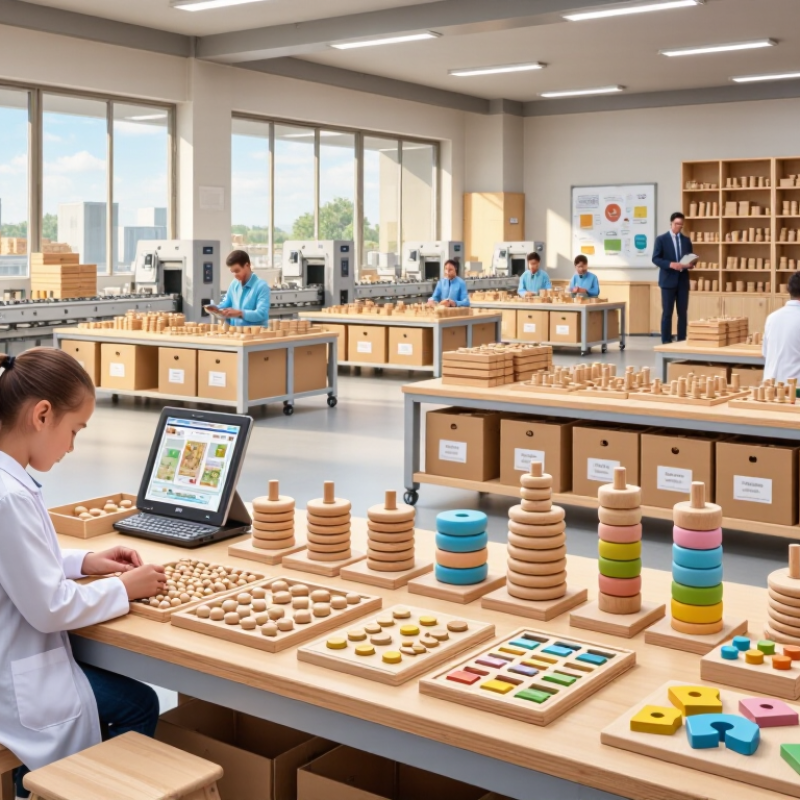
How Montessori’s 3-Year Classroom Age Bands Shape Toy-Supplier Needs
China Top 10 Montessori Toy Suppliers for Global Buyers
Montessori classrooms often group children across a three-year age band. This structure changes what global buyers should expect from Chinese toy suppliers. A classroom serving ages three to six needs materials with adjustable challenge, not single-use toys. A counting tray may suit a younger child first. Later, the same tray can support grouping, addition, or self-correction.
UNICEF reported that 175 million children lacked pre-primary education worldwide in its A World Ready to Learn report. This gap increases demand for affordable, durable learning materials. Suppliers should therefore offer clear age guidance, replaceable parts, washable surfaces, and compact packaging. OECD data also shows strong early-childhood participation across developed economies, with more than 80% of children aged three to five enrolled in 2021. Buyers need stable production for different classroom stages, not only attractive product photos.
The Global Educational Toys Market report by Grand View Research valued the sector at about USD 61.4 billion in 2022. It projected a 10.5% compound annual growth rate from 2023 to 2030. That growth sounds convincing, but procurement decisions still need practical testing. Ask suppliers to provide material specifications, safety test records, and samples from different production batches. Check whether a knob fits a child’s hand comfortably. Check whether a wooden surface remains smooth after repeated cleaning. Some catalogs look Montessori-inspired, yet the learning purpose feels weak. That is where buyers may need to slow down.
| Supplier Capability Profile | Typical Montessori Age Band | Relevant Product Examples | Supplier Capabilities Buyers Should Check | Safety and Compliance Checks |
|---|---|---|---|---|
| 1. Infant and toddler materials | Birth–3 years | Grasping objects, simple posting toys, object-permanence boxes, and large-piece stacking materials | Age-appropriate sizing, smooth surfaces, secure construction, and clear material specifications | Request testing for the intended destination market and age grade. Check applicable small-parts, choking, and mechanical-safety requirements. |
| 2. Practical-life material makers | 3–6 years; adapted versions may suit other ages | Child-sized pouring sets, dressing frames, sweeping tools, and food-preparation utensils | Consistent dimensions, functional working parts, durable handles, and replacement-part availability | Check for sharp edges, pinch points, finish safety, and suitability for the stated age group and use. |
| 3. Sensorial material specialists | 3–6 years | Color tablets, sound cylinders, geometric solids, and size-grading materials | Accurate color matching, consistent grading, repeatable dimensions, and reliable sets across production batches | Review material and coating declarations and obtain test reports for the finished product, not only its raw materials. |
| 4. Early-math material suppliers | 3–6 years; extensions may serve 6–9 years | Counting beads, number rods, numeral cards, and place-value materials | Correct quantities, clear numbering, complete sets, and packaging that prevents pieces from being lost in transit | Check piece-size risks, ink and coating safety, and labeling requirements for the destination market. |
| 5. Language-material producers | 3–6 years; literacy extensions may serve 6–9 years | Sandpaper letters, movable alphabets, object cards, and vocabulary materials | Consistent letterforms, accurate spelling, durable cards, and language or localization options | Confirm that printed materials, inks, coatings, and any included small pieces meet applicable market requirements. |
| 6. Geography and culture material makers | 3–6 years; broader studies commonly extend through 6–9 years | Map puzzles, continent materials, landform models, and cultural picture cards | Map and image accuracy, clearly identified versions, consistent puzzle-piece fit, and careful artwork review | Check product safety and verify the accuracy and permitted use of maps, images, and other supplied content. |
| 7. Wooden puzzle and construction suppliers | Varies by design; commonly 3–6 and 6–9 years | Knobbed puzzles, geometric puzzles, and simple construction materials | Stable wood sourcing, smooth finishing, reliable fit, and packaging that protects pieces from damage | Ask about wood species, coatings, adhesives, and applicable chemical and mechanical testing for the target market. |
| 8. Classroom furniture and storage makers | Designed around the intended classroom age band | Low shelves, trays, child-sized tables, and material storage units | Dimensions suited to the stated users, stable construction, rounded edges, and practical assembly instructions | Check stability, load limits, tip-over risks, finish safety, and relevant furniture requirements in the destination market. |
| 9. Custom and private-label manufacturers | Depends on the specified design and age grade | Custom classroom sets, adapted materials, and buyer-specified color or packaging variations | Prototype approval, written specifications, change control, traceable production lots, and clear minimum-order terms | Confirm who is responsible for testing, labeling, technical documentation, and compliance after any design change. |
| 10. Export-ready educational-material suppliers | Varies; request a defined age grade for every item | Mixed classroom kits, replacement components, and consolidated material sets | Accurate packing lists, export packaging, consistent replenishment, and documentation support for the buyer’s market | For the United States, ask about applicable CPSC requirements, including ASTM F963 where relevant. For the EU, check applicable toy-safety and chemical requirements. Confirm current rules for each product and market. |
FAQS
Requirements depend on the destination market. United States sales require federal toy safety compliance. European sales require conformity with regional toy rules. An international framework may help, but local law still controls. Check the latest applicable edition before production.
Testing should cover small parts, sharp edges, pull strength, impact, and flammability. Chemical checks may include heavy metals, restricted chemicals, and coating migration. Wooden toys also need paint adhesion and splinter-resistance checks. Small details matter.
Compare the report with the exact model, materials, sample photographs, production date, and batch information. Check the laboratory scope and tested age range. Ask whether packaging warnings and language requirements were included. A certificate number alone proves very little.
Review small parts, magnets, cords, edges, and likely child behavior. Do not trust the printed age label alone. Ask for the test basis and sample identification. A label cannot prove suitability for every child in that age group.
Request specifications for wood, paint, glue, fabric, plastic, and surface coatings. Confirm durability, flammability, and chemical testing where relevant. Compare documents with the actual sample and production batch. Documents can be genuine but outdated.
Look for simple activities supporting independence, concentration, sensory exploration, and self-correction. Natural colors and wooden parts are not enough. Ask how the activity suits a specific developmental stage. Some attractive designs add unnecessary lights or fixed answers.
Check edge smoothness, joint strength, finish consistency, balance, and measurable dimensions. Use a sample approval sheet with photographs. Request a production-marked sample, not only a polished showroom version. Beautiful samples can still mislead.
Review incoming material records, inspection points, worker training, and corrective-action reports. Inspect storage areas for moisture control, dust management, and batch identification. Ask how defects are handled during mass production. Photos are insufficient.
Confirm carton strength, package dimensions, shipping marks, labels, and product descriptions before production. Check that export documents match the factory’s legal details. Request a realistic schedule and recent inspection records. Written decisions help. Silence is not agreement.
No inspection guarantees every unit. Pre-shipment checks provide useful evidence, but defects can appear later. Keep batch records and repeat checks when designs or materials change. I sometimes expect documents to provide more certainty than they can.
Conclusion
This guide explores how Montessori’s three-year classroom age bands influence the design, sourcing, and customization needs of toy buyers. It explains how suppliers can support mixed-age learning through open-ended, hands-on materials that encourage independence, concentration, sensory development, and practical skills. Buyers will also learn how ASTM F963, EN 71, and ISO 8124 relate to product safety, testing, labeling, and international market access.
The article compares ten China-based suppliers by minimum order quantity, production lead time, customization capabilities, and available certifications. It also provides a practical framework for verifying age grading, material quality, and Montessori design claims rather than relying only on marketing descriptions. Finally, it outlines how to evaluate samples, conduct factory audits, review quality-control procedures, and confirm export readiness. With these checks, global buyers can select reliable partners for safe, durable, and developmentally appropriate montessori toys.